Design · Baku
Yakitori: flyer design
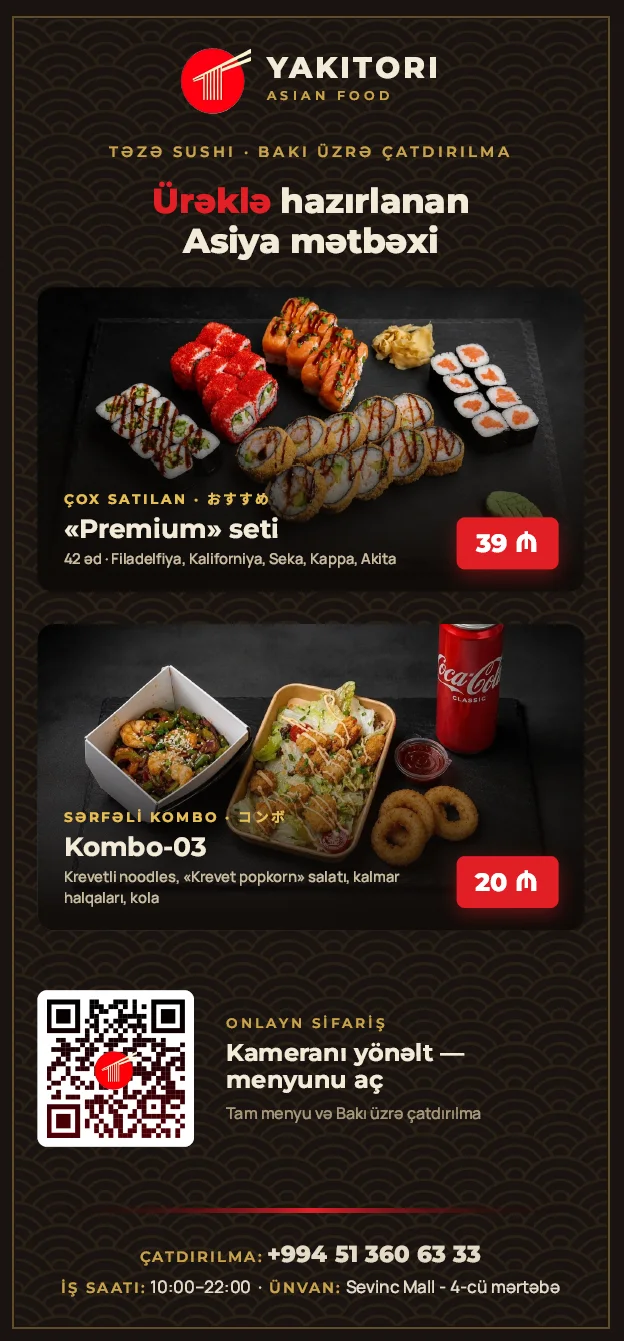
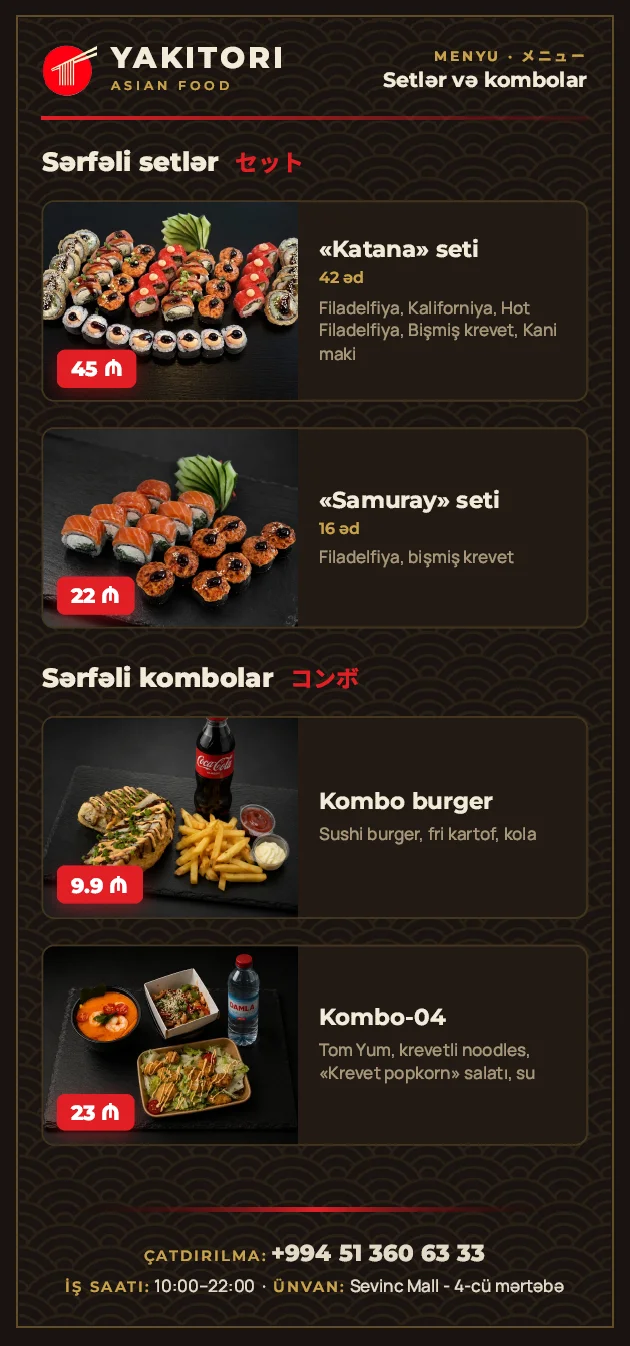
A double-sided DL flyer in the brand’s dark theme: a six-item showcase, a vector QR code to the menu site, a print PDF with type as outlines in two bleed variants, and an editable PPTX for the client.
01About the client
Yakitori · Asian Food is an Asian restaurant in Baku, on the fourth floor of Sevinc Mall. A flyer solves a different problem from the menu on the table: it is picked up on the move, looked at for a few seconds, and then either dialled or taken home. So it should not carry the whole menu but a showcase of the strongest items with prices, the phone number, and a fast route to the full menu.
02What we did
- Laid out a double-sided DL flyer, 100 by 210 mm, in the brand’s dark theme throughout: dark brown ground, a seigaiha pattern, a gold frame around the perimeter, cream text and red price badges.
- Built a six-item showcase: two large full-width shots on the front, and four horizontal cards on the back under the headings "Value sets" and "Value combos".
- Placed a vector QR code pointing to the site with the full menu. The white field and the quiet zone live inside the code itself, so no backing plate can accidentally break it; the restaurant’s logo is embedded in the centre.
- Shipped two language versions, Russian and Azerbaijani, from a shared layout: sizes, spacing, photography, prices and cropping are identical, and only the text strings differ.
- Delivered an editable PowerPoint to the client and assembled the print PDF through a separate pipeline - as with the menu, the deck is generated from measurements of the rendered page rather than from constants.
03Typography and crops
The flyer is set in points rather than pixels: this is print, and type size has to be tied to the physical size of the sheet. The footer labels are deliberately smaller than the values beside them - 6.5 points against 7.5-8: letterspaced caps read visually larger than text set tight, and at equal size they start competing with the value. Separately, a fourth typeface was cleared out of the layout: the flyer was originally set in a face that does not exist in the brand, and moving it to the brand’s Montserrat meant recalculating every size, because Montserrat runs noticeably wider.
The photography was recropped without moving a single container: the card grid did not shift by a millimetre, only the frame inside each window changed. One shot could not be fixed by an offset: a landscape photograph inside an almost square window is cropped at the sides, so moving it up or down changes nothing. That frame had to be built separately, with a slight zoom in.
04Print
- Resolution was checked for every image at the size it actually occupies on the sheet: 387 dpi at worst against a 300 dpi requirement, 882 at best. No reshoot was needed.
- Type delivered as outlines: the finished PDFs embed zero fonts and contain no font substitutions.
- The bleed ships as a second set of files, and it is made by growing the sheet rather than the artwork: the 100 by 210 mm trim block does not move, so the gold frame and the pattern stay at their own 4 and 4.5 mm from the trim line. There are no crop marks by design - at a 3 mm bleed there is no room for them, and the printer adds its own at imposition.
- The darkening over the photographs on the front is baked into the image during the print build. It is the same lesson the menu taught: a gradient with transparency over a photo came back from the printer flooded magenta. The on-screen versions and the PPTX keep the live gradient - the baking exists only in the print pipeline.
- The QR code is verified with a decoder, not by eye: the logo in the centre covers about 9.5 percent of the code area, which is within error correction, but this is not something to accept on looks. In the deck the code is rasterised to PNG rather than JPEG - JPEG would ring along the module edges and could break scanning.
05Timeline and process
Three days of work. The flyer was laid out in two language versions, and the print PDF was assembled in both bleed variants: clean trim and 3 mm bleed. The work closed on 18 August 2026, together with the site: the flyer carries a QR code pointing to the site, and without a live address it could not go to press.
Tech stack